𝐓𝐇𝐄 𝐊𝐈𝐍𝐃 𝐎𝐅 𝐌𝐎𝐓𝐄𝐋 𝐖𝐇𝐄𝐑𝐄 𝐌𝐄𝐍 𝐕𝐀𝐍𝐈𝐒𝐇 𝐀𝐍𝐃 𝐍𝐎𝐁𝐎𝐃𝐘 𝐀𝐒𝐊𝐒 𝐖𝐇𝐘
A lonely pub, a broken bell, and the sound of thunder in the Free State.

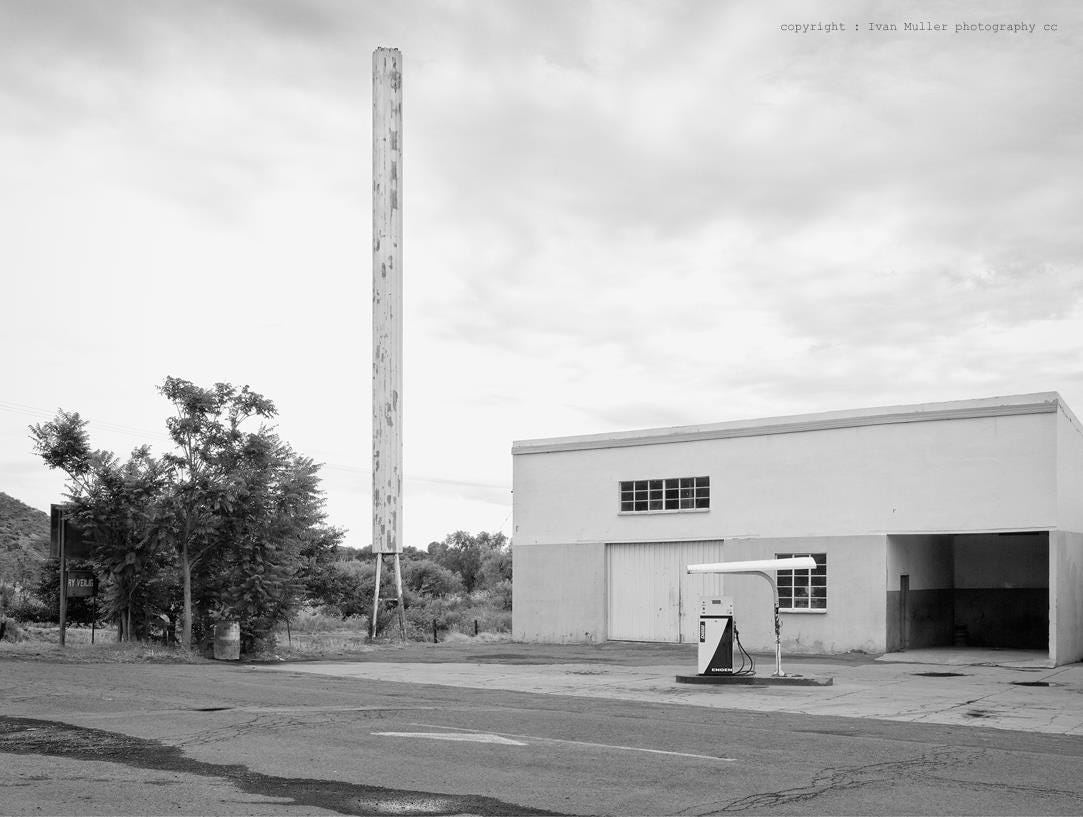
Ivan Muller took this photo of the petrol station in Trompsburg, in the Free State: it captures the mood of the place when I went there one day. This is my story:
It was a frosty winter some time back, and I was looking after a friend’s guesthouse in Springfontein, a tiny dorpie in the southern Free State. To entertain myself, I would sometimes drive over to Die Ou Kar, a fine meeting place in Bethulie with its own cast of Herman Charles Bosman characters: the man with the long beard and hollow eyes who played Boeremusiek on his accordion; the woman with a face that looked as though it had travelled many miles through life’s rough patches; and the farmer who told me he’d once been trapped under his bakkie the entire night, until sunrise, after rolling it during a bout of over-enthusiastic drinking.
Stories were plentiful and the mood was jolly and warm. I liked going there. Another place I visited was Trompsburg. One late afternoon I went; it was grey, overcast, and colder than the Antarctic (I know, I have been).
I drove slowly into the dorp and on the left I saw a sad little motel. Once out of the car, my feet crunched on the gravel as I moved towards the front door. My lips were cracked from the winter frost, my hand red and swollen.
A motel is, for me, an ecosystem of abandoned places, like the one in Bagdad Café, people and their stories that come and go, the feeling of an Edward Hopper painting, the atmosphere of a Johnny Cash song sung when he was at his most broken.
There was a hint of thunder, lightning, the smell of unrest in the distance. I was looking for a drink. The motel’s door was slightly ajar. Inside, it was a 1970s-time capsule. Very brown: Carpets, curtains, dark furniture, silence.
I saw a dining room full of tables, white tablecloths, glasses, all set for dinner. There is something ghoulish about an empty dining room in the middle of nowhere, waiting for guests who will never arrive.
At the counter there was a little rusted bell that I tried to press, but it did not ring. Broken. I called and called, with empty tables staring at me, the glasses, the cutlery. Eventually there were soft footsteps. An elderly woman appeared, startled.
“Where is the bar?” I asked. “That way,” she said, hostile. She did not trust me or like my look. It was as if she had not seen a real person for months.
I walked in. On the walls there were doodles and drawings, including one of a woman fondling her breasts. I asked for a glass of wine and the woman looked at me as if I had asked for caviar. “We only have sweet wine,” she said.
The bar was empty. There I sat, on my own, not a soul outside, nobody inside either, except for the chimera.
“Is there music?” I asked. She was irritated; I could almost feel a sharp knife in my back. Her irritation channelled the murderer Daisy de Melker.
On a scratchy speaker I heard Etta James singing “I’d Rather Go Blind”. Her voice suited the occasion. “Something told me it was over / When I saw you and her talkin’ / Something deep down in my soul said, Cry, girl, / When I saw you and that girl walkin’ around.”
I felt beaten, though I had done nothing. Outside the thunder rumbled, lightning flashed; I thought I heard the windows rattle, the rain came down. Opposite there was a hospital, unfinished, it had been started but left stranded. No love among the ruins over there, dear Etta.
I paid; the wine was poison. By the time I reached the car, I was drenched. I started the engine and put my foot down. Just as I drove out through the gates I looked in my rear-view mirror: curtains opened in a room on the top floor. A man smiled and peered through. I could see his white teeth.
Like Jack Nicholson in The Shining. When I reached the tarmac, steam rose from the asphalt. I drove back to Springfontein in silence. When I took the uneven gravel road into the dorp, it was dark, but the lightning and the headlights showed the way.