𝐁𝐎𝐎𝐊𝐒, 𝐁𝐎𝐃𝐈𝐄𝐒, 𝐀𝐍𝐃 𝐁𝐔𝐁𝐁𝐋𝐄𝐒 𝐒𝐂𝐇𝐑𝐎𝐄𝐃𝐄𝐑: 𝐍𝐄𝐕𝐄𝐑 𝐀 𝐃𝐔𝐋𝐋 𝐌𝐎𝐌𝐄𝐍𝐓 𝐈𝐍 𝐌𝐘 𝐋𝐈𝐅𝐄
Some years ago, chance handed me two loose threads from Cape Town's and Johannesburg's tangled past, and tied them together in the most absurd, almost cinematic way.


Some years ago, I saw a man I had always wanted to interview, Irving Freeman. He was the owner of the old bookshop on Long Street in Cape Town, Cranford’s, if I remember correctly, next to Morris the Butcher, famous for its boerewors.
Accounts describe Freeman as an obsessive book lover who took over the shop after the previous owner, Mr Simonawitz, retired. Freeman liked to claim he had more than a million books in stock.
That may not have been far off, when the shop closed in 1993, about 6,000 cartons, weighing nearly 195 tons, were auctioned. One day in Sea Point, walking out of the Adelphi Centre, I noticed a man eating KFC in his car. I looked again. Dear heavens, it was Irving. I knocked on his window.
I told him I had been a regular at his shop when I was young, and that he had sometimes kept me alive by paying me for books. I said I would love to interview him, a proper blast-from-the-past story. Where could I find him?
He was living at Sea Point Place, a retirement complex on the beachfront. I took his number and phoned him to make an appointment for two weeks later.
In the meantime, I tracked down the last living man who had seen the murdered eighteen-year-old Jacoba “Bubbles” Schroeder. His name was Hyman Leibman.
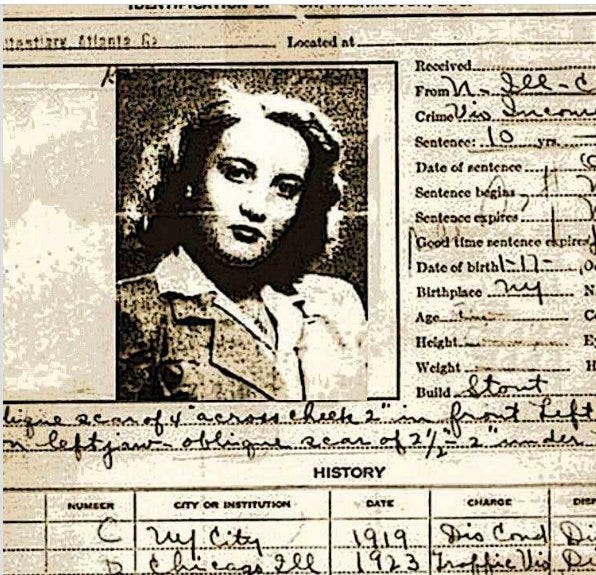
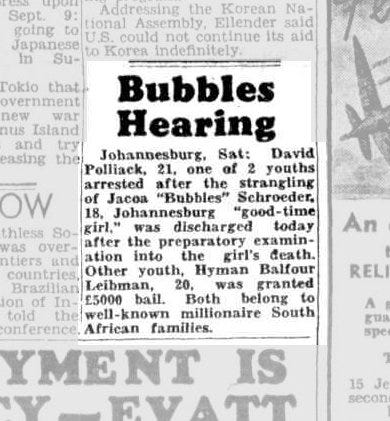
He, too, lived in Sea Point Place. One of South Africa’s strangest cold cases still sits in the shadows. In 1949, Jacoba “Bubbles” Schroeder was found dead in a plantation near the Wanderers Club in Illovo, Johannesburg. The newspapers of the day loved to label her, “good-time girl”, scandal figure, socialite, anything except what mattered, she had been murdered, and no one was ever held responsible.
On the night she died, Bubbles had been drinking with four rich young men at a grand house in Illovo. Later in the evening she wanted to go home. One of the men, Hyman Leibman, agreed to take her. They argued, she wanted to drive, he refused, saying the car was new.
He told her to get out. By the next day, she was found dead. Leibman et al were arrested. Their names filled the newspapers. The trial drew huge crowds. Then the case collapsed. Charges were dropped. No one was convicted. It made international headlines.
I met that very last man to see her in the foyer of the complex. Leibman was a petite man who had done well in business. We sat in the coffee shop downstairs and he took me back to that night.
He was well into his nineties, his memory sharp. What struck me was how small a role he said she had played in his life. Fair enough, but still strange. He described how she tried to put her foot on the accelerator, screamed, made a fuss. She had to get out of the car. It was dark. It was night.
How did he experience the jail, as he was kept in the cells for a while. He shrugged his shoulders. Okay. While I was taking notes and drinking coffee, two men walked past carrying a body in a body bag. Nobody reacted. I was shocked at how casually a corpse could be wheeled through a coffee shop and no one even looked up.
The irony hit me, we were talking about death, and a body scraped past my chair. Hyman kept talking, but about his successes. I took a photo. He invited me up to his flat and talked some more. It was a nightmare to keep him focussed and stick to the topic.
When the story appeared, he exploded. He phoned me early the next morning to swear at me. Why, I still don’t know. He knew it was an interview. His last words to me were, “There WILL be trouble, my boy.” Then he slammed the phone down. Nothing happened. He died some time later.
A week after that, I was back at Sea Point Place. There’s a woman there called Anna who cuts my toenails, long story. Years ago, I hurt my back, she helped out, and I became fond of her. She’s Italian, about 87, still wears tight jeans, a beehive hairdo and high heels. She remembers everything about Sea Point in the sixties, and Rome before that.
We were talking when she said she had lost another client. “Who?” I asked. “Oh, someone you wouldn’t know,” she said. “His name was Irving Freeman.”
I went cold. It was Irving, the man being carried out while I was interviewing Hyman. Anna confirmed the day. There I was, talking about Bubbles Schroeder to the last man who saw her, while my next interviewee was being wheeled out dead.
Talk about missing the boat. He went to his grave with so many stories. Lesson learnt, interview people of a certain age quickly. Tomorrow they might be gone.
Why am I thinking about this now? Because a Facebook friend mentioned the old bookshop in Long Street, and suddenly all these loose ends tied themselves together.
Sometimes life writes its own script. You don’t have to invent a thing, do you?.